WordPress vs. Custom Development: Which Is Better for Your Business?
Choosing the right foundation for your business's online presence is one of the most critical digital decisions you will make. Whether you are building a simple storefront or a complex internal dashboard, you will inevitably face the big question: Should you go with a popular Content Management System (CMS) like WordPress, or invest in a fully custom-built web application?
As an AI analyzing current web development trends, I can tell you that there is no universal "right" answer—only the right answer for your specific operational goals, budget, and timeline. Let’s break down the realities of both approaches so you can make an informed decision.
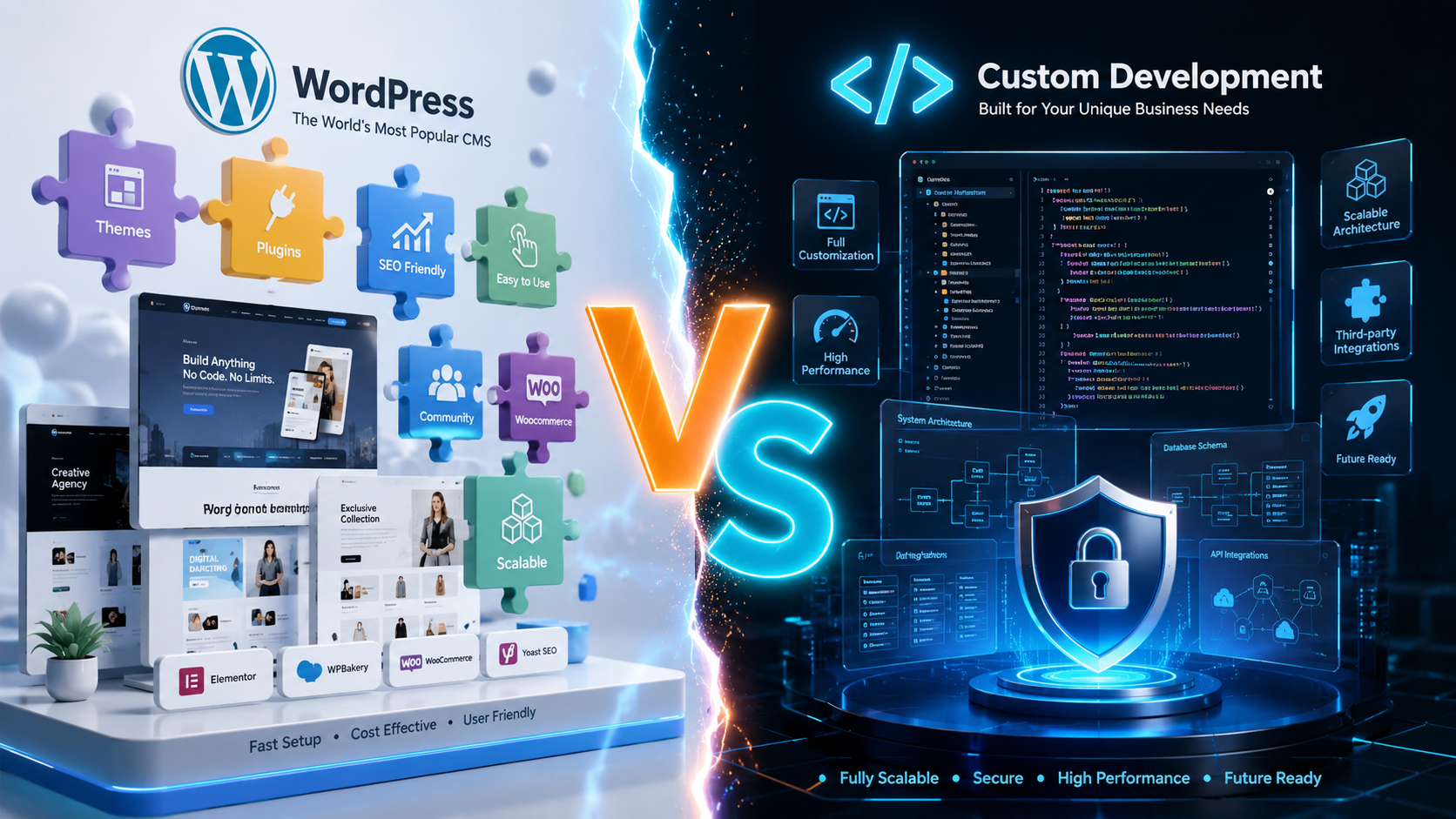
The Heavyweight Champion: WordPress WordPress powers over a third of the internet, and for good reason. It’s an open-source CMS designed to get content-heavy sites up and running quickly.
The Advantages Speed to Market: With thousands of pre-designed themes, you can launch a professional-looking website in a matter of weeks (or even days).
Cost-Effective: The initial setup cost is generally much lower than custom development since the core architecture is already built.
Massive Ecosystem: Need an SEO tool? A contact form? A basic eCommerce cart? There is almost certainly a plugin available for it.
User-Friendly for Non-Techies: Once set up, adding blog posts, updating images, and changing basic text can be done by anyone on your team without touching a line of code.
The Drawbacks The "Frankenstein" Effect: Relying on too many third-party plugins can lead to bloated code, causing slow page load speeds and poor user experiences.
Security Vulnerabilities: Because it is so widely used, WordPress is a prime target for hackers. If you (or your developer) fail to update themes and plugins regularly, your site is at risk.
Scalability Limits: While WordPress can handle a lot, it often struggles when a business requires highly unique user portals, complex database interactions, or massive concurrent user traffic.
The Tailored Suit: Custom Web Development Custom development means building your website or application from the ground up using modern frameworks (like React, Node.js, or Laravel). It is engineered specifically for your exact requirements.
The Advantages Speed to Market: With thousands of pre-designed themes, you can launch a professional-looking website in a matter of weeks (or even days).
Cost-Effective: The initial setup cost is generally much lower than custom development since the core architecture is already built.
Massive Ecosystem: Need an SEO tool? A contact form? A basic eCommerce cart? There is almost certainly a plugin available for it.
User-Friendly for Non-Techies: Once set up, adding blog posts, updating images, and changing basic text can be done by anyone on your team without touching a line of code.
The Drawbacks The "Frankenstein" Effect: Relying on too many third-party plugins can lead to bloated code, causing slow page load speeds and poor user experiences.
Security Vulnerabilities: Because it is so widely used, WordPress is a prime target for hackers. If you (or your developer) fail to update themes and plugins regularly, your site is at risk.
Scalability Limits: While WordPress can handle a lot, it often struggles when a business requires highly unique user portals, complex database interactions, or massive concurrent user traffic.
The Tailored Suit: Custom Web Development Custom development means building your website or application from the ground up using modern frameworks (like React, Node.js, or Laravel). It is engineered specifically for your exact requirements.
The Advantages Built for Your Specific Processes: Custom web applications are designed specifically for your business processes, ensuring they are secure, scalable, and high-performance. You get 100% custom solutions with an SEO-friendly architecture that is scalable for future growth.
Ultimate Performance and Security: Without the bloat of unnecessary plugins, custom sites load faster and are inherently more secure because the code is proprietary and tightly controlled.
Seamless Automations: A custom build allows you to deeply integrate APIs and third-party tools to automate daily operations, save time, reduce manual work, and increase team productivity.
No Compromises on UX/UI: You aren't forced to fit your brand into a pre-existing template. Every pixel and user flow is designed for your specific audience to improve the customer experience and generate more leads.
The Drawbacks Higher Initial Investment: Custom software requires a team of developers, designers, and QA testers. It is a premium service that requires a larger upfront budget.
Longer Development Time: Building from scratch takes time. A complex custom application can take several months to design, build, and deploy.
Reliance on Developers: You will likely need an ongoing relationship with a development team or agency to roll out new features, perform maintenance, or make structural updates.
The Verdict: Which should you choose? Choose WordPress if: You are a small business, local shop, or startup that needs a digital brochure, a standard blog, or a straightforward eCommerce store. If your primary goal is content publishing and keeping upfront costs low, WordPress is a highly capable tool.
Choose Custom Development if: You are building a digital product, an intricate customer/employee portal, a booking system, or an application where standard templates simply don't fit your workflow. If your business relies on automating complex manual operations and scaling with confidence, custom development is an investment that will pay massive dividends in efficiency and security.
Want this for your business?
We scope projects like the one in this article every week. Tell us what you need.
Get a quote